ESTA vs eTA vs Visa: Which Travel Authorization Do You Actually Need?

The Form You Only Hear About at the Airport
If your passport qualifies and the stay is short, get an ESTA or eTA; otherwise apply for a visa. An electronic authorization covers tourism, family visits, and most short business trips, and Canada’s eTA costs CAN$7. Paid work, study, or a stay past the published limit needs a visa instead.
Nobody plans a trip around paperwork, so the question usually arrives late. A friend mentions an ESTA, someone else insists Canada needs something different, and the flight leaves in nine days.
The confusion is fair, because three different products share almost the same name. A visa, an electronic travel authorization, and a visa waiver are not interchangeable, and you discover the wrong assumption at check-in.
This guide sorts out which one applies to you, why your passport rather than your destination decides it, and what each approval genuinely buys.
The Three-Question Test
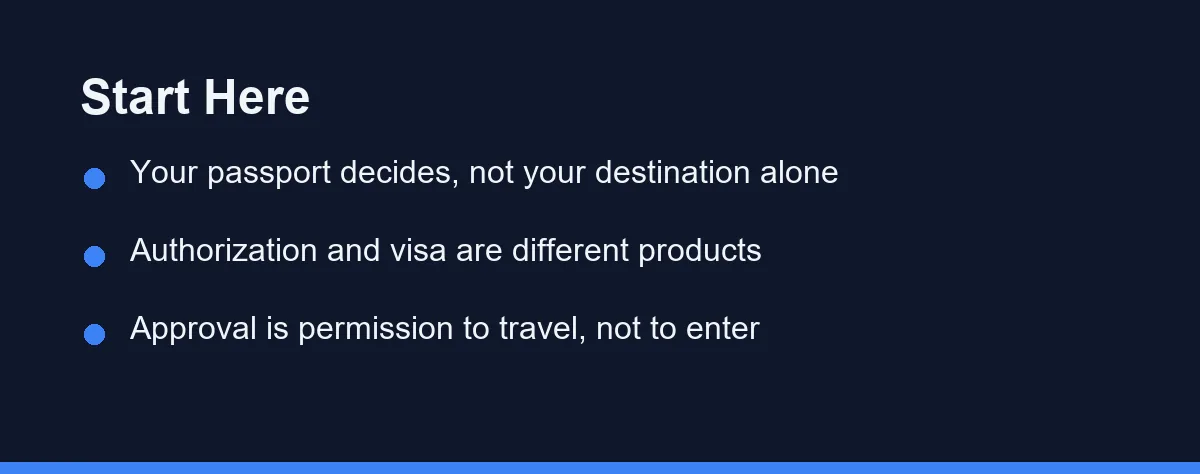
Answer three questions and the category becomes obvious. First, which passport are you travelling on? Second, what will you do there? Third, how long will you stay?
Citizenship comes first because these schemes are built around it. A country publishes a list of nationalities that may travel without a visa, and those travellers use the lighter electronic approval instead.
Purpose comes second. Tourism, visiting family, and most short business meetings fit the waiver schemes. Paid work, enrolment in a course, or anything resembling residence falls outside them.
Length comes third and settles the rest. Waiver schemes are built for short stays, and once you exceed the published limit the answer becomes a visa regardless of the first two answers.
What an Electronic Authorization Actually Is
An electronic travel authorization is a pre-screening check, not a visa. You submit passport and biographic details online, the system runs them against security and immigration databases, and it returns an approval linked to your passport number.
That approval is permission to board a flight. It is not permission to enter, which remains a decision made by an officer at the border on the day you arrive.
A visa is a heavier instrument. It usually involves an application to a consulate, supporting documents, sometimes an interview and biometrics, and it can authorise activities the waiver schemes forbid.
The practical difference is effort and lead time. An authorization is a short online form with a fast answer in most cases, while a visa is an appointment-driven process measured in weeks.
Why the Airline Is the One That Stops You
Travellers imagine the border as the checkpoint, but the enforcement happens earlier. Airlines must verify that passengers hold the documents for their destination, and they face penalties for carrying someone who is refused.
So the airline queries the destination’s system when you check in. If no approval sits against your passport number, you are not boarding, and the ticket is usually the airline’s least sympathetic category of problem.
This is why arrival is too late to fix the paperwork. The trip ends at a desk in your own departure airport, which is also why last-minute applications are risky rather than merely stressful.
The Main Schemes Side by Side

The table covers the schemes short-stay travellers meet most often. Names are confusingly similar, so read the country column rather than the abbreviation.
| Scheme | Country | Who it is for | Typical validity | Covers airport transit |
|---|---|---|---|---|
| ESTA | United States | Visa Waiver Program nationals | Two years or passport expiry | Yes, transit is a permitted use |
| eTA | Canada | Visa-exempt nationals arriving by air | Five years or passport expiry | Yes, required for airside connections |
| ETA | United Kingdom | Visa-exempt visitors | Two years or passport expiry | Check current transit exemptions |
| ETA / eVisitor | Australia | Eligible passport holders | Twelve months, short stays | Yes |
| NZeTA | New Zealand | Visa-waiver nationals and cruise passengers | Multiple years | Yes, including transit passengers |
| ETIAS | Schengen area | Visa-exempt nationals | Announced as multi-year | Rules published with launch |
| Full visa | Any country | Nationals outside the waiver list, or long stays | Varies by category | Depends on category |
Two columns deserve a second look. Validity is always capped by your passport expiry, and transit rules differ enough that a cheap connection can require paperwork the destination itself does not.
The ETIAS row is deliberately cautious. The European scheme has been announced and delayed more than once, so confirm its current status on the official EU travel information site before assuming either way, and treat any date you read elsewhere as unverified.
Your Passport Number Is the Real Key
These approvals attach to a passport number rather than to you. That single fact explains most of the awkward cases people run into.
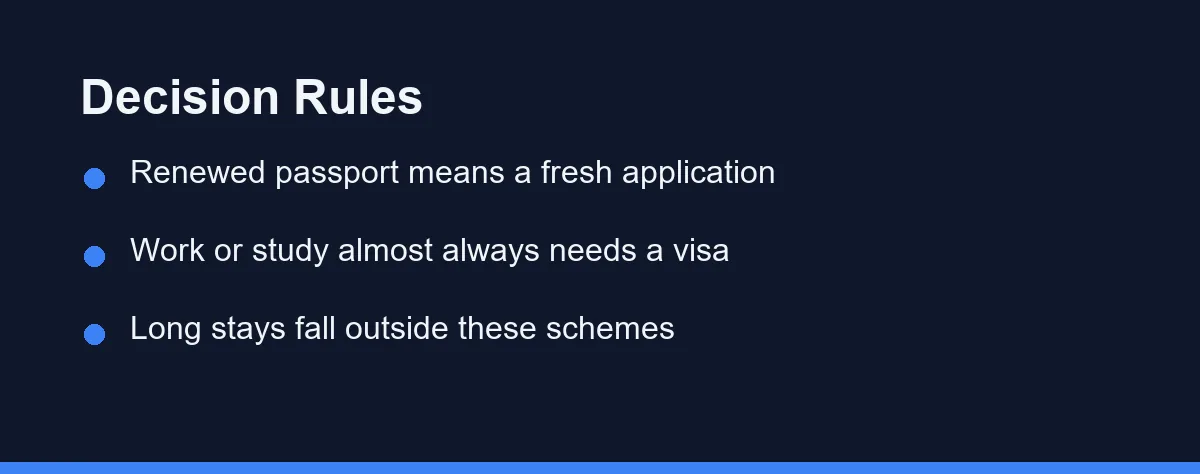
Renew your passport and the link breaks. The new book carries a new number, the old approval no longer matches, and you apply again even though the previous one had years left.
Dual nationals face a related decision. You apply using the passport you will actually travel on, and if that passport is from a country outside the waiver list, the lighter scheme is simply unavailable to you.
Name and passport details must match the booking too. A middle name entered on one and omitted on the other creates a mismatch that can hold the check-in query. The same care applies to the six-month rule covered in our passport validity guide.
Transit Counts More Often Than People Expect
Connections are where confident travellers get caught. Some countries let you stay airside without any approval, and others treat every arriving passenger as an arrival regardless of onward plans.
Entry rules can also reach past the approval itself and ask what your return plans are. We cover when that becomes a boarding problem in do you need a return ticket to enter a country.
Canada is the well-known example, since flying through a Canadian airport normally requires the eTA even when you never leave the terminal. A connection routed that way for the sake of fare savings can quietly add a document requirement.
Check the transit rule for the specific airport before you book, not after. The saving on a cheaper routing disappears the moment it forces an extra application or, worse, a denied boarding.
What These Cost, and Where the Fake Sites Live
Government fees for electronic authorizations are modest, and visas cost considerably more. Fees change, so confirm current pricing on the official immigration site at the time of writing rather than trusting a figure in an article.
| Cost line | How it behaves | What to watch |
|---|---|---|
| Electronic authorization fee | Small, one payment per applicant | Charged per person, including children |
| Visa application fee | Substantially higher, often non-refundable | Payable whether or not you are approved |
| Third-party service markup | Optional and avoidable | Copycat sites charge for form filling |
| Expedited visa appointment | Extra where offered | Not available for most waiver schemes |
| Reapplication after passport renewal | Full fee again | The most common repeat cost |
| Biometrics appointment | Applies to many visa categories | Requires travel to a centre |
The markup row is the one that costs travellers real money. Unofficial sites buy search ads, look official, and charge a premium to submit the same form you can complete yourself in fifteen minutes.
Reach the application through the country’s immigration department page rather than a search result. If a site asks for payment before showing you the government fee, close the tab.
Which Authorization Fits Your Trip
Tourist from a waiver country flying to the United States for a week: ESTA, applied for as soon as the flight is booked. Keep the approval number, and check that it still matches your current passport before you travel.
Traveller connecting through Toronto or Vancouver on the way elsewhere: Apply for the Canadian eTA even though Canada is not your destination. Airside connections at Canadian airports normally require it, and the airline will check.
Anyone whose passport was renewed since their last trip: Assume you need a fresh application. Verify rather than trust memory, because the old approval was tied to a number that no longer exists.
Someone taking a paid contract, an internship, or a full course abroad: This is visa territory, and the waiver schemes do not stretch to cover it. Start the process months ahead, since consular appointments are the bottleneck rather than the paperwork.
Traveller planning several months in one country: Compare the stay limit against your itinerary before booking anything. Exceeding the limit on a waiver scheme is an immigration matter, not an administrative one, and it affects future applications.
Digital nomad working remotely while sightseeing: Read the destination’s own wording on remote work, because policies differ and some now offer a dedicated permit. Plan connectivity separately using our eSIM versus local SIM comparison.
Mistakes That End at the Check-In Desk
Applying the night before is the most common error. Most decisions are quick, but a minority are referred for review, and no fee or phone call shortens that queue.
Assuming one approval covers a region is the second. A European trip that includes the United Kingdom and the Schengen area involves two separate systems with separate rules.
Letting someone else apply on your behalf without checking the details causes slow damage. Typos in the passport number or date of birth produce an approval that does not match your document, which is functionally the same as having none.
Forgetting the road rules is a smaller cousin of the same problem. If a rental car is part of the plan, read our international driving permit guide while you have the documents open.
Finally, do not assume children are exempt. Every traveller needs their own approval, including infants on a lap ticket, and family bookings are where a missing application usually hides.
Check the Rule for the Passport You Hold
The reliable habit is to check the requirement the same day you book, using the passport you will actually travel on. The rule follows your citizenship, not the country you live in.
Apply through the official government site, keep the confirmation with your booking, and note the expiry alongside your passport expiry. Both dates matter, and the earlier one governs.
Do that once per trip and this stops being a source of last-minute panic. It becomes a five-minute task you finish while the flight confirmation email is still open.
One case sits outside all three of these and catches people out. A connecting flight can need its own document even when you never leave the airport, which do you need a visa for a layover explains hub by hub.
There is a physical requirement hiding behind all three, because every visa needs somewhere to print. How many blank passport pages you actually need covers the counts destinations publish and why airlines check them at the gate.
Europe is the one region where the authorization itself is still on hold, because the EU has not opened ETIAS applications. The guide on whether you need ETIAS to visit Europe yet covers what the border already checks while you wait.
Visitors who come to the US for its national parks face one more cost after the ESTA. Eleven parks now add a $100 fee per adult nonresident, and whether the America the Beautiful pass is worth it works out when the $250 visitor pass cancels that charge.
FAQ
Does an approved ESTA or eTA guarantee I will be let in?
No. An approved authorization lets you board the plane and present yourself at the border. The officer at the border still decides whether to admit you, and can refuse entry even with a valid approval in the system.
Do I need to reapply after renewing my passport?
Usually yes. These approvals are linked to the passport number they were issued against, not to you as a person. A renewed passport carries a new number, so the old approval no longer matches and you need to apply again.
Do I need an authorization if I am only connecting through the country?
Often yes, and this catches people out. Some countries require their electronic authorization even when you never leave the airport, because you clear immigration to reach the connecting gate. Check the transit rule for the specific airport before booking a cheap connection.
Why do some sites charge much more for the same application?
Apply on the government site only. Copycat sites rank well in search results and charge a service markup on top of the official fee for filling in the same form. The official domains are linked from each country's immigration department page.
How far ahead should I apply?
Most systems approve the majority of applications within minutes, but a minority are held for manual review that can take days. Apply as soon as the flight is booked rather than the night before, since there is no way to speed up a review once it starts.
Sources
- Government of Canada: Electronic Travel Authorization (eTA) — checked 2026-10-15
Some links may be affiliate links. We may earn a commission at no extra cost to you.
How this article was made: it was drafted with AI assistance from the official sources listed above, and its figures were checked against those pages on the dates shown. It is not based on personal hands-on testing.
Comments
Post a Comment