Can You Bring Tools on a Plane? The 7 Inch Rule and Its Exceptions

Hand Tools Up to Seven Inches Fly in the Cabin
Yes, hand tools 7 inches or shorter can fly in your carry-on, while power tools and longer tools go in the hold. That is the core of TSA’s tools page. It lists tools as allowed in carry-on with special instructions, and the instruction is the length.
The rule has firm exceptions. Hammers, crowbars, saws and utility knives fail in the cabin at any size. Drills and drill bits travel in checked bags only, while spare lithium batteries for those tools must travel with you in the cabin.
The rest of this guide explains how TSA measures the 7 inches, sorts twelve common tools into the right bag, and packs out two realistic toolkits. It ends with a packing plan for carry-on travelers and for anyone checking a bag.
The Seven Inch Line and How TSA Measures It

TSA uses one length for most hand tools. Its screwdriver page says tools 7 inches or shorter, measured from end to end when assembled, are allowed in carry-on baggage.
The words when assembled matter more than they look. A bit driver with an extension, or a socket wrench with a socket fitted, counts as one piece. Take the tool apart and the pieces may each pass, but an officer can reasonably judge what they become together.
The wrenches and pliers page states the other side of the line. Tools longer than 7 inches are prohibited in carry-on baggage and must be packed in checked bags. A standard 8 inch adjustable wrench therefore belongs in the hold, even though it looks harmless.
Why a ruler beats a guess
Tool sizes on packaging can mislead. Many makers name products by jaw size or blade length, not overall length, so a tool sold as a 6 inch model may run longer handle to tip.
Lay each tool on a ruler at home, assembled the way you would use it. Anything at or under 7 inches can ride in the cabin, and anything over goes in the checked bag. TSA adds that the final decision rests with the officer at the checkpoint, so leave some margin on borderline pieces.
Tools That Fail at Any Length
Some tools have no length allowance at all. TSA’s item pages list hammers and crowbars as not allowed in carry-on bags, with no size condition attached. A small tack hammer gets the same answer as a framing hammer.
Saws follow the same pattern. TSA lists saws as checked bag only, and the page names cordless portable power saws as included. Pack any saw blade sheathed or wrapped, since TSA asks for that on sharp objects in checked bags to protect handlers and inspectors.
Utility knives and box cutters are the strictest case. TSA requires them in checked bags with or without blades, so an empty handle still fails in the cabin. Our guide to scissors and pocket knives on a plane covers the rest of the blade family, including the 4 inch scissors rule.
Power Tools Split Between Two Bags
Power tools are where many travelers get caught, because the tool and its battery go in different bags. TSA’s power tools page says power tools must be packed in checked bags, including drills and drill bits.
The batteries reverse that rule. The same page says spare, uninstalled lithium batteries and battery chargers that do not need electricity must be packed in a carry-on bag. A battery left installed in the drill rides with the drill in the hold.
TSA adds that batteries installed in devices must be protected from accidental activation. Lock the trigger if the tool has a lock, or remove the battery and carry it. For lithium battery size limits, TSA points travelers to FAA rules, and our guide to power banks in carry-on bags explains how those battery limits work for spares.
Twelve Common Tools Sorted Into the Right Bag
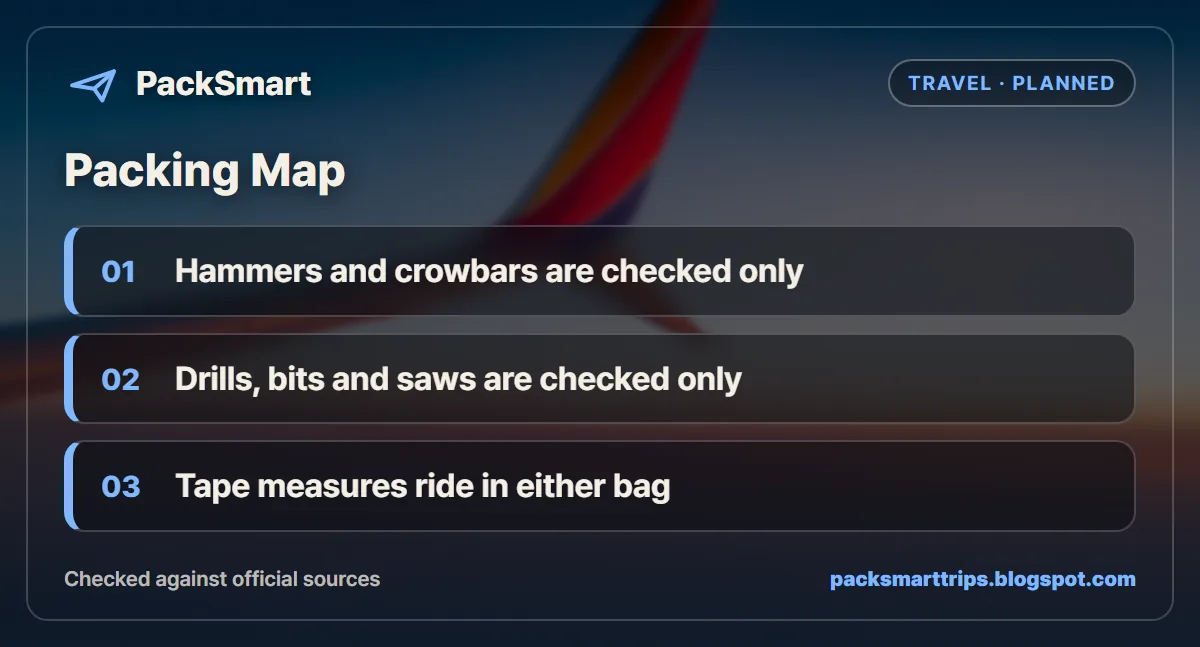
The table collects the TSA item pages checked for this guide on October 31, 2026. The carry-on column decides your packing, since TSA allows every tool itself in checked luggage.
| Tool | Carry-on | Checked bag | TSA condition |
|---|---|---|---|
| Screwdriver, 7 inches or shorter | Yes | Yes | Measured end to end when assembled |
| Screwdriver, longer than 7 inches | No | Yes | Checked bag only |
| Wrench or pliers, 7 inches or shorter | Yes | Yes | Same 7 inch rule |
| Wrench or pliers, longer than 7 inches | No | Yes | Checked bag only |
| Hammer, any size | No | Yes | No length allowance |
| Crowbar, any size | No | Yes | No length allowance |
| Saw, including cordless power saws | No | Yes | Sheathe or wrap the blade |
| Drill and drill bits | No | Yes | Power tools go in the hold |
| Spare lithium tool battery | Yes | No | Spares must be in carry-on |
| Utility knife or box cutter | No | Yes | Checked with or without blades |
| Tape measure | Yes | Yes | No condition listed |
| Lock picks, 7 inches or shorter | Yes | Yes | Check local law first |
Two patterns stand out. Only hand tools with a length rule can ever reach the cabin, and the spare battery is the one item that must stay out of the hold. Everything else simply needs a checked bag.
A Handyman Kit and a Cordless Drill Kit, Packed Item by Item
Picture two travelers heading to the same job site. The first flies carry-on only with a small hand-tool roll, and the second checks one duffel with a cordless drill. The lengths below are examples measured end to end, and the bag choice follows the TSA pages.
| Item | Example length or type | Carry-on only traveler | One checked bag traveler |
|---|---|---|---|
| Stubby screwdriver | 4 inches | Carry-on | Carry-on |
| Long screwdriver | 10 inches | Shipped or bought there | Checked |
| Adjustable wrench | 6 inches | Carry-on | Carry-on |
| Adjustable wrench | 8 inches | Shipped or bought there | Checked |
| Claw hammer | Any | Shipped or bought there | Checked |
| Cordless drill with bits | Battery removed | Not packed | Checked |
| Spare drill battery | Lithium, uninstalled | Not packed | Carry-on |
| Tape measure | 25 foot reel | Carry-on | Carry-on |
The carry-on traveler keeps 3 of the 8 items and must source the hammer, the long screwdriver and the larger wrench at the destination. The checked-bag traveler keeps everything, but splits the drill and its spare battery across two bags.
The 6 inch wrench passes and the 8 inch version fails, even though they do the same job. That 2 inch gap is why buying short versions of your most-used tools pays off for frequent flyers. The choice between carry-on and checked luggage usually decides the toolkit before you reach the checkpoint.
When Shipping the Toolbox Beats Checking It
A heavy toolbox can push a checked bag over the weight limit. Airlines set their own weight caps and fees, so check yours before you pack a full kit.
For a long job or a large kit, sending the tools ahead can be simpler. Our comparison of checking a bag versus shipping luggage ahead walks through when shipping makes sense. Spare lithium batteries carry their own shipping rules, so confirm them with the carrier first.
Gate Checks and Tools in Your Roller Bag
A tool that passed screening can still create a problem at the gate. If the bins fill and the agent tags your roller bag for the hold, any spare lithium battery inside must come out first.
Keep spare batteries and chargers in a small pouch you can lift out in seconds. Our guide to what happens when your carry-on gets gate-checked explains what to pull from the bag before it goes below.
Rules Change Outside the United States
These TSA pages govern screening at US airports only. Other countries use their own prohibited items lists, and some set tighter limits on tools in the cabin. A screwdriver that cleared on the way out may fail on the return flight.
Check the departure airport security rules before you fly home. When in doubt, move every tool into the checked bag and keep only the spare batteries with you.
Which Packing Plan Fits Your Toolkit

Carry-on only with a small repair kit: Pack screwdrivers, wrenches and pliers measuring 7 inches or less, plus a tape measure. Buy or borrow a hammer at the destination.
Contractor checking one bag: Put power tools, long tools, hammers and saws in the checked bag, with blades wrapped. Carry spare lithium batteries and chargers in the cabin.
Hobbyist flying with a cordless drill: The drill and bits go in the hold. Remove the spare batteries and keep them with you, and lock the trigger on any battery left installed.
Locksmith or lock-sport traveler: Picks 7 inches or shorter can ride in the cabin under TSA rules. TSA also tells travelers to check local law at the destination.
Anyone unsure about a borderline tool: Measure it end to end, assembled. If it lands near 7 inches, pack it in the checked bag rather than gamble at the belt.
Measure at Home, Then Split the Kit
The whole topic reduces to three checks. Measure each hand tool, assembled, against the 7 inch line. Then send hammers, crowbars, saws, blades and power tools to the hold, and keep spare batteries with you.
Do it with a ruler and the TSA tools page open, the night before you fly. Confirm the current rules before each trip, because TSA updates its lists and the officer at the checkpoint makes the final call.
FAQ
Can you bring a screwdriver in your carry-on?
Yes, if the tool is 7 inches or shorter. TSA allows screwdrivers, wrenches, pliers and similar hand tools in carry-on bags at that length, measured end to end when assembled. Longer tools must go in checked luggage.
Can I bring a cordless drill on a plane?
No. TSA lists power tools, including drills and drill bits, as checked bag only. Spare lithium batteries for the tool are the exception, since TSA says spare, uninstalled lithium batteries must be packed in a carry-on bag.
Can you bring a hammer in carry-on luggage?
No. TSA lists hammers and crowbars as not allowed in carry-on bags, with no length allowance. Both are fine in checked luggage.
How does TSA measure the 7 inch tool limit?
TSA says the 7 inch length is measured from end to end when the tool is assembled. A screwdriver with a removable bit counts at its assembled length, so measure it with the bit in place.
Can I bring a tape measure or utility knife through security?
Yes. TSA lists tape measures as allowed in both carry-on and checked bags. Utility knives and box cutters are different, and TSA requires them in checked bags with or without blades.
Sources
- TSA What Can I Bring: Tools — checked 2026-10-31
- TSA What Can I Bring: Screwdrivers (shorter than 7 inches) — checked 2026-10-31
- TSA What Can I Bring: Screwdriver (longer than 7 inches) — checked 2026-10-31
- TSA What Can I Bring: Wrenches/Pliers — checked 2026-10-31
- TSA What Can I Bring: Power tools — checked 2026-10-31
- TSA What Can I Bring: Hammers — checked 2026-10-31
- TSA What Can I Bring: Crowbars — checked 2026-10-31
- TSA What Can I Bring: Saws — checked 2026-10-31
- TSA What Can I Bring: Utility knives — checked 2026-10-31
- TSA What Can I Bring: Tape measures — checked 2026-10-31
- TSA What Can I Bring: Lock picks — checked 2026-10-31
Some links may be affiliate links. We may earn a commission at no extra cost to you.
How this article was made: it was drafted with AI assistance from the official sources listed above, and its figures were checked against those pages on the dates shown. It is not based on personal hands-on testing.
Comments
Post a Comment