Solid vs Liquid Toiletries: Carry-On Only Without the Liquids Bag
The One Pouch in Your Bag That Never Gets Bigger
For most carry-on-only travelers, switch shampoo, conditioner, and toothpaste to solids, and keep medical liquids and sunscreen as liquids. Those three swaps free the most pouch space. Contact lens solution and prescription liquids have no reliable solid substitute, so they stay.
The quart-size liquids bag is the tightest real estate in carry-on travel. Everything else in your bag scales with the bag itself, but that pouch never grows. Solid toiletries exist mostly to get items out of it.
That reframing matters more than any single product. Switching to a shampoo bar is not a shopping decision, it is a decision about which items compete for a fixed volume. Once you see the pouch as a budget, the whole packing system changes.
This guide treats solid and liquid toiletries as two halves of one system rather than a product roundup. It covers what screening actually classifies as a liquid, which categories convert cleanly, and which stubbornly do not. Climate, storage, and the medical-exemption path all shape the final mix.
By the end you should be able to build a toiletry kit that clears security without a checked bag. The goal is a pouch with room to spare, not a purist all-solid kit. Most travelers land somewhere in the middle, and that is the correct answer.
Three Swaps Free the Most Room Fastest

For travelers whose liquids bag is overflowing, converting shampoo, conditioner, and toothpaste to solids frees the most room fastest. Those three are bulky, heavy, and have mature solid formats. They are the highest-leverage swaps available.
For anything medical, corrective, or coverage-critical, keep the liquid. Contact lens solution, prescription liquids, and high-SPF sunscreen for a long beach day do not have reliable solid substitutes. Forcing a swap there trades convenience for risk.
The realistic outcome is a hybrid kit. Solids handle the bulk items, the quart bag holds the few things that must stay liquid, and medical liquids travel under a separate exemption. That mix survives a real trip better than any all-or-nothing approach.
What the Screening Rule Actually Covers
Start by learning what the screening rule actually covers. The familiar 3-1-1 style limit in the United States caps each container at 3.4 oz (100 milliliters), with all containers fitting inside one quart-size resealable bag, one bag per traveler. The category is broader than “liquid” suggests.
Gels, pastes, creams, aerosols, and spreadable substances are all screened under the same rule. Toothpaste, mascara, deodorant gel, and aerosol dry shampoo are liquids for this purpose even though nobody pours them. That misunderstanding is what fills most travelers’ pouches.
Watch the “not quite solid” middle ground closely. Twist-up stick deodorant is generally treated as a solid, but gel-format stick deodorant is not. A lip balm is fine, while a lip gloss is a liquid, and the difference is texture rather than packaging.
Regional variation is real and worth checking before you pack. The 100 millilitre and one-litre bag standard is common across the UK and EU, though several airports have deployed newer CT scanners that relax the rule locally and inconsistently. Confirm current limits with the security authority operating your departure airport, and check tsa.gov for US specifics.
Note that the rule applies per departure, not per trip. A connecting flight through another region resets you to that region’s limits, and duty-free liquids bought airside can create problems downstream. Travelers on multi-leg itineraries should plan for the strictest checkpoint on the route.
Finally, judge each solid product on whether it actually replaces the liquid’s function. A conditioner bar that leaves hair tangled is not a swap, it is a downgrade you will regret on day three. Function first, format second.
Category by Category, Not Product by Product
The practical decision is category by category rather than product by product. Some toiletries have solid formats that match or beat the liquid version, and others do not. Sorting them honestly is the whole exercise.
Categories That Convert Cleanly
Shampoo and conditioner are the flagship conversions. Bars from brands like Ethique and Lush have been around long enough that formulation quality is no longer the gamble it once was. They also outlast a small travel bottle on most trips.
Toothpaste tablets, sold by brands such as Bite and Huppy, are dry and chewable. You bite one, brush, and it foams like paste. They screen as solids and eliminate the single messiest item in most kits.
Solid perfume, bar soap, stick sunscreen, and balm-format moisturizer round out the easy wins. Each replaces a liquid with a comparable solid at similar performance. Together they can empty half a quart bag.
Categories That Do Not Convert
Contact lens solution has no solid equivalent, and improvising with anything else risks your eyes. It stays a liquid, and travel sizes usually fit the container rule. Buy more at your destination rather than rationing.
Prescription liquids, including liquid medication, saline, and some medical devices’ fluids, also stay liquid. So do liquid makeup formulas where a solid version genuinely changes the finish. Accept these as fixed costs in your pouch budget.
High-SPF coverage is the underrated exception. Stick sunscreen is convenient, but achieving the labeled protection requires a thick, even layer that sticks formats make harder to apply consistently. For a full beach day, a lotion is the more reliable protection.
How Each Format Screens and Travels

The table compares common toiletry formats on how they are screened and how they behave in real travel. Treat it as a planning aid rather than a ruling. Screening officers always have final discretion at the checkpoint.
| Item | Format | Counts toward liquids limit | Practical notes |
|---|---|---|---|
| Ethique solid shampoo bar | Solid | No | Outlasts a travel bottle; needs a vented tin |
| Lush solid conditioner bar | Solid | No | Works best on fine to medium hair |
| Bite toothpaste bits | Solid tablet | No | Dry, spill-proof, easy to show at screening |
| Standard tube toothpaste | Paste | Yes | Must meet container-size rule |
| Cadence or GoToob travel bottles | Liquid decanted | Yes | Leak-resistant, but still fills the pouch |
| Quart-size bag baseline | Liquid container | Yes | One bag per traveler in most regions |
| Stick sunscreen | Solid | No | Convenient; harder to apply at labeled SPF |
| Contact lens solution | Liquid | Yes | No solid substitute; keep travel size |
Two patterns stand out on a single scan. Anything dry or waxy skips the pouch entirely, and anything pourable, spreadable, or pressurized does not. Format determines screening far more than the product’s purpose does.
Silicone bottle sets from Cadence or GoToob still deserve a place in the system. They do not dodge the limit, but they make the liquids you must carry leak-resistant and right-sized. That is a different problem worth solving separately.
Empty the Bag Onto a Table First
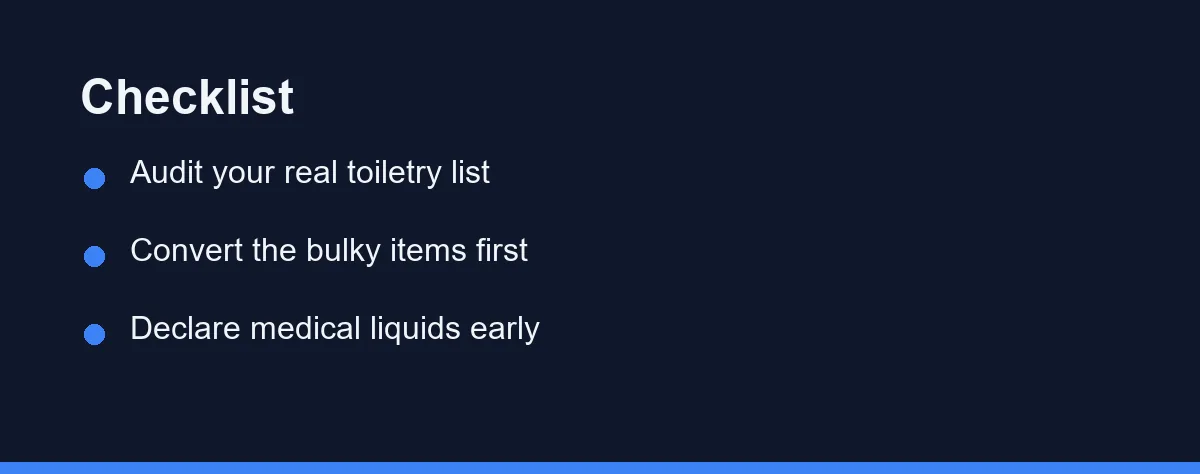
Begin by emptying your current toiletry bag onto a table. Sort every item into three piles: must stay liquid, converts easily, and rarely used. Most travelers find the third pile is larger than expected.
Convert the bulkiest items first, because they return the most pouch volume per swap. Shampoo, conditioner, and toothpaste almost always top that list. Leave the marginal items alone until the obvious wins are done.
Factor in your destination’s climate before committing to solids. Humid conditions keep bars soft and slow to dry, which invites mush and mildew in a sealed container. A vented tin or a slotted travel case makes a real difference on tropical trips.
Consider trip length and whether you can buy replacements locally. Short trips rarely justify a full conversion, since travel-size liquids already fit. Longer trips, where liquid volume runs out, favor solids more strongly. Our guide on carry-on vs checked luggage covers when the whole constraint disappears.
Handle medical liquids through the exemption path rather than the pouch. Medically necessary liquids, including prescription medication, are generally permitted in reasonable quantities above the standard limit. Declare them at the start of screening, keep them separate from the quart bag, and expect additional inspection.
Finally, choose based on your real routine rather than an idealized one. A minimal kit you actually use beats a photogenic one that leaves you buying replacements on arrival. How the kit fits your bag matters too, as our packing cubes vs compression bags guide explains.
Travel Size Labels Still Get Refused
A handful of errors cause most checkpoint problems. Each is easy to fix once you know it exists.
Do not assume anything labeled “travel size” is compliant. Some travel bottles exceed the container limit, and screening reads the printed capacity rather than the fill level. A half-full oversized bottle is still refused.
Do not treat aerosols as solids because they feel dry. Aerosol dry shampoo and spray deodorant are screened as liquids despite the name and texture. That surprise costs travelers a favorite product regularly.
Do not bury medical liquids inside your quart bag. They belong separate and declared, which is both the rule and the faster path through screening. Mixing them slows everyone down.
Do not pack a wet bar into a sealed container. Trapped moisture turns a shampoo bar to paste and can grow mildew within a day or two. Let it dry, then use a vented tin.
Do not convert everything just to say you did. Contact solution, prescription liquids, and reliable sun protection are worth their pouch space. Purity is not the goal, a functional kit is.
Do not assume one region’s rule applies everywhere on your route. A connection through a stricter airport governs what you can carry from that point. Plan for the tightest checkpoint on the itinerary.
Higher Upfront, Cheaper Per Trip
Solid toiletries generally sit in the low to mid tier for personal care products. A single bar often costs more upfront than a comparable bottle but lasts noticeably longer. Confirm current pricing on the official site, as of 2026.
Toothpaste tablets and solid perfume typically land in the mid tier per unit. Subscription options from the major brands usually reduce the per-use cost. Refill pouches are the cheaper route once you settle on a product.
Silicone travel bottle sets span budget to premium depending on the valve and cap design. Premium sets from names like Cadence and GoToob charge for leak resistance and modularity. For frequent travelers, the leak-proofing is where the money goes.
The overall switch is inexpensive to test. One shampoo bar and one pack of toothpaste tablets is enough to learn whether the format suits you. Expand only after a real trip confirms it works.
Judge value by trips per unit rather than sticker price. A bar that survives three trips beats a cheaper bottle you refill and replace constantly. Durability and reliability matter more than the initial number.
Who Should Switch to Bars
Solo traveler on a weekend trip: Change nothing and decant instead. Two or three days of shampoo and toothpaste fit inside standard travel bottles with pouch space left over, so a conversion buys you nothing. A leak-resistant set from Cadence or GoToob solves the only real risk here, which is spillage rather than volume.
Family sharing one quart bag per person: Convert shampoo and conditioner for the whole group to bars first. Shared liquids multiply fast, and one family-size bottle instantly breaks the container rule while a single bar serves everyone. Keep children’s prescription liquids out of the pouch entirely and declare them at the checkpoint.
Long trip of a month or more: Solids win decisively because they outlast travel bottles rather than running dry mid-route. A shampoo bar and a tin of Bite or Huppy tablets survive far longer than a decanted 100 millilitre bottle you would otherwise need to replace abroad. Pack a vented tin so the bar can dry between hostels or guesthouses.
Strict carry-on-only flyer with no checked bag ever: Go hybrid rather than purist and treat the pouch as reserved space. Convert shampoo, conditioner, toothpaste, and moisturizer to solids, then keep only contact lens solution and any prescription liquid in the bag. That leaves genuine slack for a checkpoint that enforces the rule tightly.
Beach or tropical destination: Keep lotion sunscreen despite the pouch cost, and manage humidity for everything else. Stick formats are convenient but make an even, labeled-SPF layer harder to achieve across a full day outdoors. Store bars in a slotted case, because sealed containers in humid air turn a shampoo bar to paste within days.
Win the Liquids Bag, Ignore the Rest
For travelers fighting a crowded liquids bag, solid shampoo, conditioner, and toothpaste return the most space for the least effort. Those three categories have mature solid formats that genuinely replace the liquid. Start there and stop when the pouch has room.
For medical, corrective, and coverage-critical items, the liquid stays. Contact solution, prescription liquids, and dependable high-SPF sunscreen are not places to experiment. Their pouch space is a cost worth paying.
The right kit is a hybrid built around a fixed volume budget. Audit what you carry, convert the bulky items, store bars where they can dry, and declare medical liquids separately. That system travels better than any single product recommendation.
Rules change and vary by region, so confirm current limits with the security authority operating your departure airport before every trip. That habit prevents more problems than any gear choice. For related reading, see our guides on packing cubes vs compression bags and travel backpack vs suitcase for Europe trips.
Food competes for the same quart bag, and the same solid-or-liquid test decides it. Our guide to bringing food through airport security shows which snacks travel free and which count against your limit.
Shaving kits add a second rule on top of the liquids limit, because loose blades cannot ride in the cabin. We cover each razor type in whether you can bring a razor in your carry-on.
FAQ
Does a shampoo bar count toward the carry-on liquids limit?
A solid shampoo bar is not treated as a liquid, gel, or aerosol, so it normally rides outside the quart-size bag and does not eat into your allowance. That is the entire reason travelers switch. Rules can change, so confirm current limits with the security authority operating your departure airport.
Are toothpaste tablets allowed through airport security?
Toothpaste tablets are dry, so they are generally screened as a solid rather than a paste. Standard tube toothpaste is a paste and must fit the container-size rule. Screening officers still hold final say at the checkpoint, so pack tablets where they are easy to show.
Can you bring sunscreen in a carry-on bag?
Yes, sunscreen is allowed in a carry-on when it meets the container-size and bag rules for liquids. Stick and balm formats are screened as solids and avoid the limit entirely. Larger tubes for a beach trip are usually easier to place in checked luggage.
Is stick deodorant considered a liquid at airport security?
Twist-up stick deodorant is generally screened as a solid and rides outside the liquids bag, while gel and aerosol formats are treated as liquids despite feeling dry. The texture decides the classification, not the packaging. Officers keep final discretion, so pack the format you can show quickly.
How do you pack a shampoo bar so it does not melt?
Store a bar in a vented tin or slotted case so trapped moisture can escape, and let it dry before sealing anything. A wet bar in an airtight container softens into paste and can grow mildew within a day or two. Humid destinations make this the difference between a usable bar and a ruined one.
Sources
- EPA: A Brief Guide to Mold, Moisture and Your Home — checked 2026-10-15
- TSA: Liquids, Aerosols, and Gels Rule — checked 2026-10-15
Some links may be affiliate links. We may earn a commission at no extra cost to you.
How this article was made: it was drafted with AI assistance from the official sources listed above, and its figures were checked against those pages on the dates shown. It is not based on personal hands-on testing.
Comments
Post a Comment